

What if I’m not doing the right thing
I get asked this question a lot by parents of neurodivergent children who are worried about trying new strategies or who do parenting in ways that don’t map neatly onto conventional notions of parenting. What I mean by ‘conventional notions of parenting’ is expectations that children will be obedient, that parents set the agenda and children will comply, that children can be drilled in particular behaviours by rewards or negative consequences for disobedience. (See this great blog by Sussex Psychological Therapy Centre on why this conventional approach doesn’t work so well with neurodivergent children.) Next to this conventional approach; where parents of neurodivergent children are using, for example, low demand parenting; other parents or professionals might interpret such an approach as lax parenting.
I’m not sure exactly sure what the answer to the (title) question is, but I think I can break down the question in ways that can be helpful, to consider instead: How can I make a good decision about what I do?
- Firstly, I’m not convinced that there is a singular and absolute ‘right thing’ that applies all the time. What ‘right’ might look like depends on your child (or children), what they need, who you are, what you believe, and what you need. Ultimately, it’s probably constantly renegotiated as part of the relationship between you. So rather than ‘right’, a reframe in terms of ‘needs’ might be useful. What does your child need? What do you need? I’m going to borrow and adapt Maslow’s Hierarchy of Needs to give some prompts to think about this. I’m not going to think about these prompts as a hierarchy though, because in different circumstances, different considerations might be paramount:
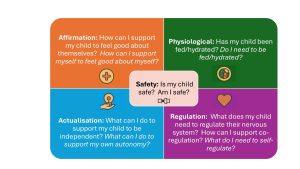
By considering both your needs and your child’s (your children’s) you’ll have a perspective to inform what decisions you make.
- The second point I want to make is that we can easily get stuck in patterns of thinking that tell us ‘I can’t’. ‘I can’t try this because…’, ‘This won’t work because…’. Sometimes we feel so worn down that we tell ourselves by default that something won’t work, but we don’t give it a chance. If you have a sense of what your child needs (and maybe you’ve got some information on this), and you know that maybe something isn’t quite working, this gives you something to go on, a starting point. All you need is a chink of possibility, ‘I could try…’, ‘If X then I could do Y…’. It might be that you can start small, ‘if this condition is in place then…’ or ‘a first step could be…’. Thinking in this finer detailed way can help us to move towards a decision. So rather than look for ‘what’s right’ we can look for ‘what’s possible.’
If this post has resonated with you and you want to find some ways to reframe ‘am I doing this right’ thinking, please reach out to us at info@careforyoucoaching.co.uk